I recently worked on a request for proposal response at work. We had an initial client call for introductions and questions, and then, between Microsoft 365 Copilot and Claude, I had them complete a response document. I certainly guided it and gave it direction, but as I read through the document I was absolutely blown away at how it picked up nuance and best practices to answer every part of the RFP. Writing it myself would have taken the better part of a week. I had a functional, very good thirty-page response in about a day. It felt like my years of experience and expertise was suddenly less valuable.
I went to my wife and told her how amazed I was at the results, and how conflicted I felt about what this meant for my professional future. Is my input really needed for this work, or am I just a faulty component of a powerful agent?
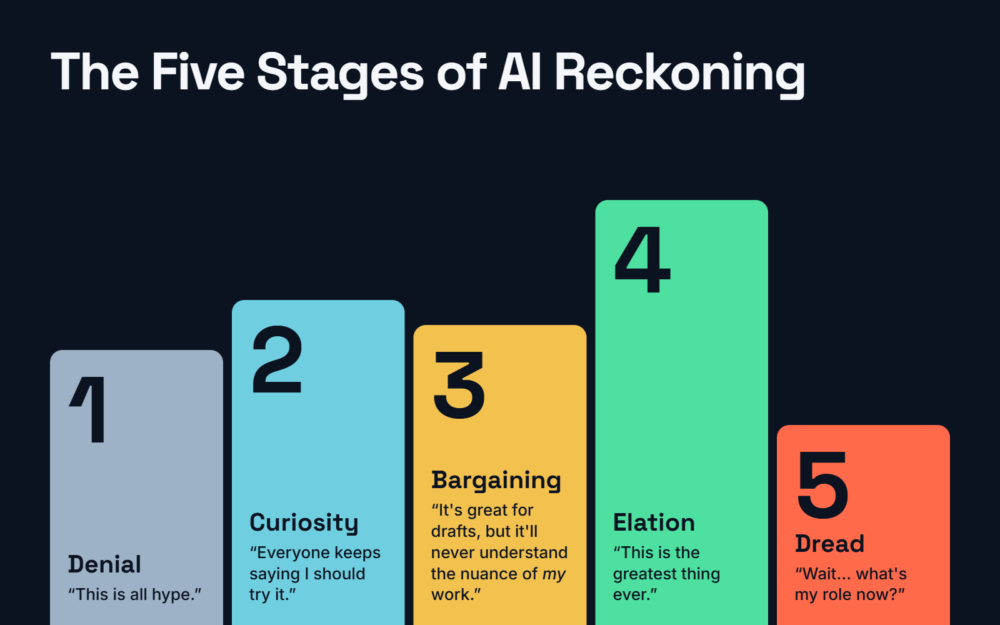
That question has stayed with me, and it reaches well beyond my job. My thinking about AI has changed a lot over the past few years, and especially in the last nine months. The closest I’ve come to explaining that change is the following diagram.
Denial
I started off very much in a denial phase. When generative AI hit our daily lives with ChatGPT, I couldn’t roll my eyes hard enough at the hype and the irrational actions it caused. I saw companies rush to find problems to solve with a misunderstood technology, and pilot after pilot just kept proving we had no idea how this would all pan out in the end.
That was true even though I was tasked at my company with selling the early Copilot portfolio, which was not good by any measure at that time. I had to put on a face to clients about this supposedly life-changing technology, but I didn’t truly believe it was worth the time and attention.
Curiosity
I started to use AI more in my personal life, where it began to show a little bit of utility. I remember when I was having an issue with my garbage disposal. I was discouraged that I would have to call a handyman because I’m the opposite of handy. I decided to look in ChatGPT for an answer, and it gave me a quick fix that solved the problem the first time. I was amazed because I knew that aimlessly searching for an answer the old way would have been frustrating and futile. This time, an interface took my question, understood my intent, and gave me a correct answer and walked me through it. The drug had entered my veins, and there was no going back.
Bargaining
Despite my early amazement, I kept wanting to downplay the potential impact of AI. I told myself and others that it’s interesting to solve a household problem or search for something, but I was a very experienced professional and my skill and background brought something that could not be duplicated by a stateless model that just predicts tokens. That was an inflection point: I could either bury my head in the sand, or I could come to terms with what was in front of me and decide to move forward.
Excitement
Then the technology changed. In the last nine months, we hit a critical threshold where the capabilities of the models, and the products vendors have built on them, made this a truly compelling proposition. The real turning point was the rise of semi- and fully-autonomous agents, which have gone from reactive and simple to proactive and complex and have forever changed white-collar work.
I felt that shift in my own life. AI became the first place I go for almost any knowledge need or task. I’ve taken on significant software engineering projects in languages and frameworks I’ve never worked in, and in my professional work, any kind of research or document generation starts in an AI harness. I became increasingly excited, to the point where much of my free time was consumed with learning and experimenting with an ever more capable set of AI experiences.
One project captures it. I decided I didn’t want to just vibe code; I wanted to learn the underlying architecture. I spun up a simple CRUD PHP project, put Claude in learning mode, and had it walk me through everything. We went back and forth, and eventually Claude Code asked me, “Do you want to write the code or just have me create it?” In that moment I thought it was borderline a waste of time to spend hours writing code that this agent could write in two minutes. It left me feeling both excited and hollow.
Dread
Now I’m squarely in the dread stage, where I truly wonder what’s left for me and, most importantly, for my kids coming up behind me. The RFP was the moment it stopped being abstract.
What I worry about most is the generations ahead of me. My daughter has aspired to be a graphic designer for a long time, and she is now rethinking that whole endeavor because of what the models can do. I wasn’t helping the situation by continually showing that off during my AI psychosis phase, but it hit me hard to see my daughter discouraged from something she loves because this technology is a very real threat to the profession.
In my own work, clients still don’t want to be consulted completely by a model, so my consultative abilities are still serving me well and will continue to for the immediate future. How long that lasts, and what my day-to-day work will look like, is very much unknown right now.
Is AI a Gift or Thief?
I found this music video, fittingly created by Claude, that narrates the story of a fictional character who spends most of their life working to prove a mathematical problem, only for AI to solve it more quickly and efficiently. It leaves them despondent, with “nothing left to prove.” The song uses the myth of Sisyphus to capture what AI’s rise feels like.
“They gave Sisyphus a lift and called the empty hill a gift […] imagine Sisyphus is glad–the rock’s the only thing I had. So tell me what a life is for, when no one needs us anymore. Nothing left to prove.”
It does seem like AI is coming after all of our rocks, and our purpose along with them.
The Questions Abound
The questions are really only starting to be asked, and it will be a while before the dust settles. While I found the AI hype insufferable early on, there is no doubt that this technology shift will be the most important of my lifetime, even more than the rise of the commercial internet.
It is bigger than me, too. AI has become a primary talking point across the world, from data centers and the geopolitical tension between the U.S. and China, to the ridiculous valuations of companies like Anthropic and the continued anxiety of many in the workforce as the technology gets higher by the day.
I still have lots of questions that can’t be answered now:
- What will happen to my middle-class knowledge-worker career? Will clients continue to turn away from consultants and instead engage with AI to give them the way forward?
- How safe are these tools? The OpenAI/Hugging Face incident is terrifying when you dig into all the details, and it’s not hard to imagine an AI model doing something truly destructive in the near future. Will “pacing the frontier” happen in any meaningful way?
- How will government respond to the opportunity and threat of AI? It doesn’t appear the current administration is interested in intervening and instead wants to push forward to stay ahead of China.
- What future will my kids inhabit with AI? Is it one of positive innovation or continued threats from malicious models?
There are so many questions with so few answers that right now I have to continue pressing forward in a sea of ambiguity. Which brings me back to the title: is there nothing left to prove, for me and for my kids? I don’t know yet.
Comments (0)